
Why Every Building Needs an Asset Register
A building asset register is a single record of every physical asset in a building, what it is, where it is, when it was installed, and what has been done to it since.
It exists so that decisions about maintenance, budgets, and replacement can be made from evidence rather than memory. Without one, a building is managed by whatever breaks next.
Say, for example, the lift fails on a Friday afternoon. The contractor asks how old the motor is, when it was last serviced, and whether it is still under warranty. Nobody in the building can answer any of the three questions, so the contractor prices the job for the worst case, and that price is what the owners corporation pays.
This happens in buildings that are otherwise well run. It is not a failure of care or of budget. It is a failure of record. Somewhere between the developer who installed the motor, the two building managers who have come and gone since, and the committee that has turned over twice, the knowledge of what is actually in the building stopped being written down.
A building is not one asset. It is thousands
Owners buy into a building and think of it as a single thing they collectively own. Operationally, it is thousands of separate items, each with its own age, condition, service interval, warranty, and replacement cost.
Pumps, switchboards, lifts, fire doors, hydrants, sprinkler heads, extractor fans, roller doors, intercom panels, pool filtration, irrigation controllers, louvres, gutters, balustrades, car park bollards, EV chargers, and the roof itself. Each one fails eventually. Each one costs money to replace. Each one has a service history that either exists or does not.
The register is what turns that mass of individual items into something a committee can actually govern. Not a list of possessions, but a list of future costs and current obligations, with dates attached.
What an asset register actually records
A register that cannot tell you what an asset is, where it is, and what has happened to it is an inventory, not a register. At minimum, each entry should carry:
| Field | Why it matters |
|---|---|
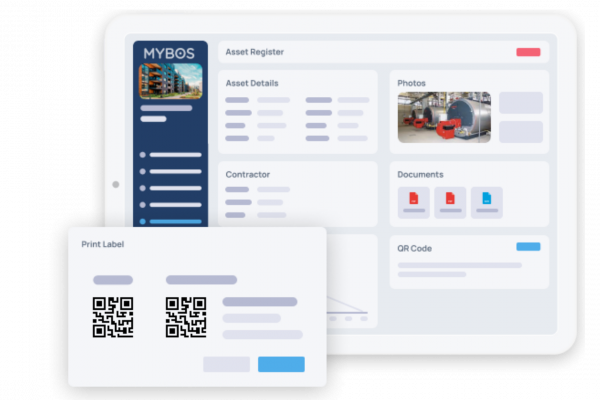
| Asset identifier | The reference that ties this asset to every work order, invoice, and service report about it |
| Type and description | What it actually is, in enough detail that a contractor can quote without a site visit |
| Location | Which level, which plant room, which riser. “Basement” is not a location |
| Make, model, and serial number | What parts fit it, and what the manufacturer will honour |
| Installation or commissioning date | The start of the clock for expected life and for warranty |
| Warranty expiry | Whether the repair you are about to pay for should be free |
| Service interval and last service date | Whether the asset is compliant right now, and when it next falls due |
| Condition and expected remaining life | The input the capital works plan runs on |
| Replacement cost estimate | What the building needs to have saved before this item fails |
| Responsible party | Owners corporation, lot owner, or a shared arrangement. This is where disputes start |
The last four fields are the ones most often left blank, and they are the ones that turn a register from an administrative artefact into a financial planning tool. A register without condition, remaining life, and replacement cost cannot tell a committee anything about next year.
Think of it the way you think about servicing a car
A car with a complete service history is worth more than the same car without one, and the difference is not sentiment. The service book proves the timing belt was changed at the right interval, the oil wasn’t left in for four years, and the warranty claim will be honoured.
Buy a car with no service history, and you are not buying a cheaper car. You are buying an unknown, and you price it accordingly, which is exactly what the lift contractor did on that Friday afternoon.
Now scale that from one vehicle to several thousand items, spread across twenty levels, owned collectively by a hundred people who each hold a fraction of the cost. That is a building. The asset register is its service book, and buildings are routinely run without one in a way no owner would tolerate for their own car.
Why so many buildings still don’t have one
There are three reasons, and none of them is negligence. They are all structural, which is why the problem persists in buildings with competent managers and engaged committees.
- Nobody was ever handed one. The building changed hands, or the managing agent changed, or the on-site manager moved to another site, and the register was not part of what transferred. What transferred were keys, contracts, and an email archive. The knowledge of the building walked out with the person who held it.
- It is a large job with no deadline. Walking a building and cataloguing every asset properly takes weeks. No month makes it urgent, and there is always something urgent this month. So it stays on the list.
- It looks like it already exists. There is a spreadsheet from 2019, a defects list from handover, and a servicing schedule that one contractor maintains for their own scope. Three partial records that feel, collectively, like a register, until someone asks a question that requires all three to agree, and they do not.
What it costs when the register does not exist
The cost shows up as special levies. An asset fails, no money was set aside for it, and the shortfall is raised from owners as an unbudgeted charge, often at short notice and frequently in dispute.
A special levy is not the price of the pump. It is the price of not having known the pump’s age. An asset with a documented installation date, condition rating, and replacement estimate becomes a line in the capital works fund years before it fails. The same asset, undocumented, becomes an emergency and a vote at a general meeting.
The second cost is paying twice. Without a service history tied to a specific asset, the same fault gets diagnosed from scratch by whichever contractor attends, and recurring problems are treated as new ones indefinitely. Buildings can spend heavily on maintenance for a decade and have nothing to show a committee that asks what the money bought.
The compliance and liability position
Beyond the money, the register is increasingly what a building is asked to produce. Regulators, insurers, and incoming committees do not ask what was done. They ask what can be shown.
New South Wales has now legislated part of this at the point of handover.
From 1 April 2026, an original owner must prepare a building’s initial maintenance schedule using a mandated standard form, and must give evidence of it to the owners corporation at least 14 days before the first annual general meeting. For multi-storey schemes, the schedule must be reviewed and certified by an independent surveyor who is not connected with the developer, and who is either a Certified Quantity Surveyor with the Australian Institute of Quantity Surveyors or a Chartered Quantity Surveyor with the Royal Institution of Chartered Surveyors. That same surveyor must also verify that the initial levy estimates cover expected expenditure for the year following the first AGM.
(Sources: NSW Government, Guide to strata law changes for strata committees and owners, and Australian College of Professionals, Initial maintenance schedules for the surveyor qualification and the 14-day deadline. Both accessed 8 September 2026. New South Wales only, and only for new strata and community land schemes.)
An initial maintenance schedule is not the same document as an asset register. It is narrower, and it addresses the developer’s handover obligation rather than the building’s ongoing record. But the direction is clear enough. New buildings in New South Wales now start life with structured, certified data about their assets, which makes the stock of existing buildings without any such record the outlier rather than the norm.
Two related changes are worth knowing. Where a scheme revises its 10-year capital works fund plan, or replaces a plan that has been in place for ten years, the new standard form applies. And from 1 October 2026, new and returning strata committee members in New South Wales must complete a free annual online training course within three months of appointment, with exemptions for two-lot schemes, strata managing agents, and short casual vacancies.
Fire safety is where the absence of records becomes a penalty rather than an inconvenience. Failing to provide an annual fire safety statement attracts escalating weekly penalty notices. Burwood Council publishes the scale as $1,000 for the first week, $2,000 for the second, $3,000 for the third, and $4,000 for the fourth week onward, under Schedule 5 of the Environmental Planning and Assessment (Development Certification and Fire Safety) Regulation 2021. Failing to maintain the essential fire safety measures themselves is a separate offence.
(Source: Burwood Council, Fire safety non-compliance, accessed 8 September 2026. Published amounts are indicative and vary by council.)
A statement is signed on the basis that each measure has been assessed as performing to its design standard. That assessment depends on knowing which measures the building has, where they are, and when each was last inspected, which is the asset register, whether or not anyone calls it that.
Shared assets, and who actually pays for what
Where a driveway, a substation, a fire system, or a set of lifts serves more than one scheme, the cost of maintaining it is apportioned between the parties that share it, and the register is what makes that apportionment defensible.
In New South Wales, the arrangement usually has two named parts. A building management statement sets out the rights, obligations, and cost-sharing rules for shared infrastructure across the lots or schemes it covers. A building management committee is the body that administers it, made up of representatives of each scheme with an interest in the shared assets.
Neither can operate on assumptions. If the register does not record that a fire pump serves two schemes at a stated proportion, then every invoice for that pump becomes a negotiation, and every negotiation is conducted by whoever happens to hold the committee seats that year. Where the register does record it, the split is arithmetic.
This is also the section most worth a legal read for any specific building, because the apportionment rules live in the building management statement for that scheme, not in a general principle.
What we are seeing change
The buildings coming to us now ask different questions than they did five years ago, and the shift is generational rather than technological.
Managers who ran buildings reactively, competently, on relationships and recall, for twenty years, are retiring. The people replacing them have not inherited that recall and do not want to operate on it. They ask for the asset list before they ask for the keys, because their exposure is personal and they have watched what happens to a manager who cannot produce a record.
We should be honest that MYBOS has an interest in this being true. It is an observation from the buildings we onboard rather than an industry statistic, and it is offered as such. But it matches what readers who manage buildings tend to recognise from their own sites.
What a usable asset register looks like
The difference between a register that gets used and a spreadsheet that gets forgotten is not sophistication. It is a handful of unglamorous properties:
- One place. Every asset in the same record, not split across a spreadsheet, a contractor’s system, and a filing cabinet.
- Linked to the work. Every work order and service visit attaches to the asset it concerns, so failure history assembles itself instead of being reconstructed.
- Dates that fall due. Service intervals that generate the next task rather than sitting as reference data nobody reads.
- Condition and cost, kept current. The two fields the capital works plan depends on, reviewed rather than entered once at setup.
- Responsibility recorded. Owners corporation, lot owner, or shared under a building management statement, stated per asset.
- Survives a handover. The test that matters most. If the register only makes sense to the person who built it, the building does not have one, that person does.
If you are weighing up what kind of system you actually need, the distinction between building asset management and asset tracking is worth understanding before you shop, because the two solve different problems and are often sold as the same thing.
Sources
Every legislative and penalty figure in this article traces to a published source. Where a claim could not be verified, it is not stated.
- NSW Government — Guide to strata law changes for strata committees and owners.
- Australian College of Professionals — Initial maintenance schedules.
- Burwood Council — Fire safety non-compliance.
Legislation changes. Figures published by individual councils are indicative and vary between council areas, so confirm the current position for your own building and jurisdiction before relying on any number here.