What Is Facility Management? A Plain Guide for Australian Buildings
Every building has a list of things that have to keep working. The lifts need servicing, the fire panel needs testing, the cleaners need to turn up, the air conditioning has to cope with a 40-degree day, and someone has to know which contractor fixed the roof last time and whether it’s still under warranty. Most people never think about that list until something on it fails.
Facility management is the discipline that owns that list. It sits behind every office tower, apartment building, hospital, school and shopping centre in Australia, and it’s one of the most misunderstood jobs in property.
Quick answer: Facility management is the work of keeping a building and the services inside it running safely, compliantly and cost-effectively for the people who use it. The international standard ISO 41001 defines it as the organisational function that integrates people, place and process within the built environment. In practice, that means maintenance, compliance, cleaning, security, contractors, energy, and the records that tie them all together.
What is facility management?
The most widely used definition comes from the international facility management standard, ISO 41001, published in April 2018: facility management is “the organisational function that integrates people, place and process within the built environment, with the purpose of improving the quality of life of people and the productivity of the core business.” (Chartered Quality Institute, July 2018).
Put more simply: the building exists to serve whatever happens inside it, whether that’s residents living their lives, staff doing their jobs or patients getting care. Facility management makes sure the building does that job well, every day, without anyone having to think about it.
It’s easy to confuse facility management with neighbouring disciplines, so it helps to separate them:
| Discipline | Main focus | Typical question it answers |
|---|---|---|
| Facility management | The building’s operation and the services inside it | Is everything working, safe and compliant today? |
| Property management | The asset as an investment: leases, rent and tenants | Is the building earning what it should? |
| Strata management | Governance and finances of an owners corporation | Are levies, meetings and records in order? |
| Building management | Day-to-day running of a specific building on site | What needs doing in this building this week? |
In practice these roles overlap heavily. In many Australian apartment buildings, the building manager is effectively doing facility management on site, while the strata manager handles governance.
Hard services vs soft services
Facility management work is usually split into two groups.
Hard services relate to the physical fabric and systems of the building. They tend to be safety-critical, regulated and expensive when they fail.
Soft services relate to the people using the building and how the space feels. They’re more visible day to day and shape how occupants experience the place.
| Hard services | Soft services |
|---|---|
| HVAC and air conditioning | Cleaning and waste management |
| Fire protection and essential safety measures | Security and access control |
| Lifts and escalators | Reception, concierge and mailroom |
| Plumbing, electrical and hot water | Grounds, gardens and landscaping |
| Roofs, facades and building fabric | Pest control |
| Building management systems | Space planning and amenity bookings |
A facility manager doesn’t need to deliver all of these personally. The job is making sure each one is delivered, to the right standard, by the right people, with a record to prove it.
What does facility management cover in an Australian building?
Maintenance
Planned and reactive maintenance is the core of most facility management work: servicing plant on schedule, responding to faults and keeping a history of every job. Getting the balance right matters, because running a building on breakdowns is consistently more expensive than planning ahead. Our guide to reactive vs planned maintenance breaks down the real cost.
Compliance and safety
Australian buildings carry a heavy compliance load. Fire protection systems are routinely serviced to AS 1851, which sets monthly, six-monthly and yearly tasks. (Standards Australia, AS 1851-2012). In Victoria, owners must maintain essential safety measures and prepare an Annual Essential Safety Measures Report. (Fire Rescue Victoria, September 2025). And under the model Work Health and Safety laws, a person with management or control of a workplace must ensure, so far as is reasonably practicable, that the workplace and its fixtures are without risk to health and safety. (Safe Work Australia, model WHS Act interpretive guideline). Facility management is usually where those obligations become schedules, inspections and records.
Energy and sustainability
Energy is one of the largest operating costs in most commercial buildings, and disclosure is increasingly expected. Under the federal Commercial Building Disclosure program, office spaces of 1,000 square metres or more generally need a current NABERS Energy rating when they’re offered for sale or lease. (Commercial Building Disclosure program, Australian Government). Facility managers typically own the data and the operational changes that move that rating.
Contractors and vendors
Very few buildings deliver every service in-house. A typical building relies on a dozen or more contractors, from lift technicians to cleaners. Facility management covers engaging them, checking their insurances and licences, scheduling their work, signing it off and paying for it.
Assets and long-term planning
Every lift, pump, fire panel and roof membrane has a lifespan. Knowing what you have, its condition and when it’s due for replacement is what turns a maintenance budget into a defensible long-term plan. That starts with an asset register — our guide to why every building needs an asset register covers how to build one.
People and occupants
Facility management is ultimately about the people in the building. That includes handling requests and complaints, communicating planned works and outages, and making sure shared spaces are safe, clean and available when people need them.
Three ways to deliver facility management
Organisations generally choose one of three models, and many use a mix. If you’re weighing in-house against outsourced maintenance specifically, our guide to outsourcing vs in-house property maintenance compares the two in detail.
| Model | How it works | Best suited to |
|---|---|---|
| In-house | Your own staff manage and deliver most services | Single sites or organisations wanting tight control |
| Outsourced (single-service) | Separate contractors for each service, managed by your team | Most residential and mid-sized commercial buildings |
| Integrated | One provider or team manages multiple services under one contract and structure | Large portfolios, campuses, hospitals and government estates |
Integrated facility management is growing quickly in Australia. Mordor Intelligence values the Australian integrated facility management market at around US$17.1 billion in 2025, with forecast growth of 8.3% a year to 2031. (Mordor Intelligence, May 2026). Our guide to integrated facilities management explains what that model asks of your systems.
Facility management vs the facility manager
This guide is about the discipline: what facility management is and what it covers. If you’re interested in the role itself — the day-to-day duties, responsibilities and skills — our guide to what a facility manager does covers the job in detail.
Where software fits in facility management
For a long time, facility management ran on spreadsheets, paper logbooks and email chains. That works until the person holding it all together goes on leave, or until a compliance audit asks for three years of service records.
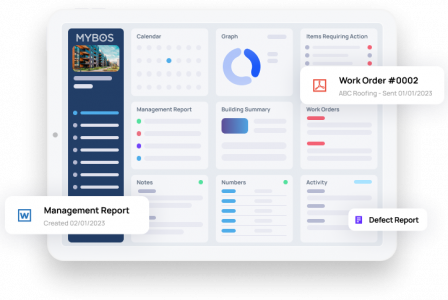
Modern facility management platforms bring the moving parts into one place: an asset register, maintenance schedules, work orders, contractor records, compliance tasks and reporting. The point isn’t the software itself. It’s having one reliable record of what’s happened in the building, so decisions are based on evidence rather than memory. It also makes performance measurable — see our guide to the top metrics for facility operations reporting.